The Ministry of Reconciliation: The Mission We Cannot Forget
Primary Scripture: 2 Corinthians 5:14–21
Additional Scriptures: Genesis 3; Romans 5:10–11; Ephesians 2:13–22; John 20:21–22; Jeremiah 29:7; Colossians 3:17; Colossians 1:19–20
We Have Been Reconciled for a Purpose
In our previous class, The Spirit Within, we explored an extraordinary truth: through Christ, God has made His home in us by His Spirit. We are not simply people who believe in God from a distance. We have been brought into a living relationship with Him, and His Spirit is at work within us, forming our character and transforming the way we live.
But this leads us to another important question: Why has God placed His Spirit within us?
Is it simply to help us feel closer to Him? Is it only for our personal spiritual growth, our prayers, or our experiences when we gather as a church? All these things have their place, but God’s purpose goes further.
The Spirit who lives within us also prepares us to participate in God’s mission in the world. Through Christ, God has reconciled us to Himself, and now He calls us to become people through whom others can encounter His love, truth, peace, and restoring work. The apostle Paul describes this responsibility as the ministry of reconciliation.
In this class, we will explore what reconciliation means, why it matters, and how it changes the way we live. We will discover that reconciliation is not simply about resolving disagreements or helping people get along. It is part of God’s much greater purpose of restoring what sin has broken through Jesus Christ.
And we will see that this mission belongs not only to pastors, church leaders, or missionaries. It belongs to every follower of Jesus.
Our central idea: God reconciles us through Christ, forms us by His Spirit, and sends us into the world as representatives of His Kingdom.
Before You Begin
Think about this question:
When you hear the word “reconciliation,” what comes to mind?
Perhaps you think about two friends repairing a broken relationship, a family finding peace after an argument, or people learning to forgive one another.
These are meaningful examples. But as we study Scripture, we will discover that biblical reconciliation begins somewhere much deeper.
1. Something Broke: Understanding Our Need for Reconciliation
Read: Genesis 3:1–24
To understand reconciliation, we first need to understand why it became necessary.
The Bible begins with a picture of God’s good creation. Humanity was created in His image, given purpose, and entrusted with the responsibility of caring for the world. Human beings were meant to live in relationship with God, with themselves, with one another, and with the rest of creation. These relationships were connected. Humanity’s relationship with God was intended to shape every other part of life.
But Genesis 3 introduces a devastating change. When humanity chose to distrust and disobey God, sin entered the human story. What followed was more than the violation of a rule. Sin damaged the relationships through which human life was meant to flourish.
Adam and Eve hid from God. They became ashamed and afraid. They began blaming one another. Even their relationship with the ground they were called to cultivate became marked by struggle. The consequences of sin reached into every dimension of life.
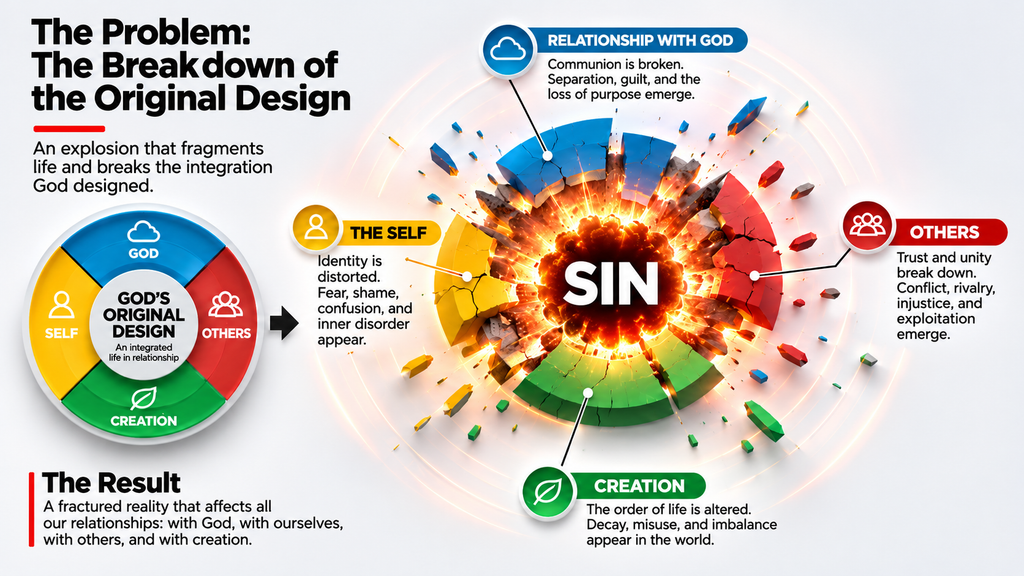
Four Relationships Affected by Sin
Our relationship with God. Humanity moved from open fellowship with God into alienation, fear, and disobedience. Sin disrupted the communion for which we were created.
Our relationship with ourselves. Shame, guilt, fear, and distorted desires became part of the human experience. We struggle to understand our identity and live according to our God-given purpose.
Our relationship with others. Relationships became vulnerable to jealousy, selfishness, hostility, violence, injustice, and exploitation. Instead of consistently loving and protecting one another, people often use others for their own benefit.
Our relationship with creation. The world we were entrusted to care for became a place of frustration and struggle. Our relationship with the environment can become marked by neglect, exploitation, and irresponsible use of resources.
Imagine a beautiful design in which all the pieces belong together. Now imagine an explosion at its center. The pieces are still present, but their relationships have been disrupted. What was designed for harmony has become fractured. This gives us a picture of the effects of sin. The biblical story is not simply about people making mistakes. It is about humanity becoming alienated from the God who gives life and purpose to everything, and this is why reconciliation matters.
God’s response to this brokenness is not to abandon His creation. Throughout Scripture, we see His purpose to redeem humanity and bring about restoration through Christ.
Reflect
Where do you see the consequences of broken relationships in the world today?
Think beyond personal disagreements. Consider families, workplaces, communities, and our treatment of creation.
2. God Takes the First Step
Read: 2 Corinthians 5:18–19 and Romans 5:10–11
When a relationship breaks down, we often wonder who should take the first step toward repairing it. Who should apologize? Who should reach out? Who should make things right? When it comes to our relationship with God, Scripture gives us an extraordinary answer.
God took the initiative.
Paul tells us in 2 Corinthians 5 that reconciliation comes from God. It is God who reconciles us to Himself through Christ. This is essential to understanding the gospel. Humanity did not find a way to climb back to God through good behavior, religious performance, or personal improvement. God acted in grace to accomplish what we could not accomplish for ourselves.
Romans 5:10 explains that we were reconciled to God through the death of His Son while we were still His enemies. Think about what this means. God did not wait for humanity to become worthy of His love. He moved toward us while we were alienated from Him.
This is the foundation of reconciliation: God’s initiative, God’s grace, and God’s action through Jesus Christ. Sometimes, Christians unintentionally communicate a different message. We tell people that they must clean up their lives, overcome every struggle, or become better people before approaching God.
But the gospel announces something greater. God has opened the way to reconciliation through Christ. We are invited to respond in faith, turn toward Him, and receive the new life He offers. This does not mean repentance and transformation are unnecessary. It means they are responses to God’s grace rather than achievements that earn it. We are not reconciled because we successfully changed ourselves. We are changed because God has reconciled us to Himself through Christ.
A Thought to Remember
Reconciliation is first something God has done for us before it becomes something God works through us.
Reflect
How does knowing that God took the initiative change the way you understand His love?
How might it also change the way you approach people who are struggling or far from God?
3. Jesus Christ: The Center of Reconciliation
Read: 2 Corinthians 5:14–17 and Ephesians 2:13–18
God’s reconciliation is not simply a general message about love or forgiveness. It is accomplished through a specific person: Jesus Christ.
Through His death and resurrection, Jesus dealt with the sin that alienated humanity from God and opened the way for restored relationship with Him. But Paul explains that something even greater has begun. In 2 Corinthians 5:17, he declares that anyone who is in Christ belongs to the new creation. This means that reconciliation is not merely about receiving forgiveness for our past. It is also about entering a new reality in Christ.
We are no longer defined primarily by our failures, backgrounds, achievements, social positions, or the divisions that have shaped human history. Our deepest identity is now found in Jesus.
A New Humanity
In Ephesians 2, Paul describes how Christ brought Jews and Gentiles together, overcoming the hostility that had separated them. These were communities with different histories, traditions, and identities. Yet through Christ, God was creating one new humanity. This does not mean people lose their cultures, personalities, or individual experiences. It means those differences no longer have the authority to determine who belongs to God’s family. Christ becomes the foundation of a new kind of community.
A community where people who once considered one another outsiders can become brothers and sisters.
A community where forgiveness becomes possible.
A community where human dignity is not determined by wealth, ethnicity, education, nationality, or status.
This is one of the most beautiful implications of reconciliation.
Jesus does not simply bring isolated individuals back to God. He creates a people who belong to God and to one another. However, we must remember that this new humanity is not something we create through human effort. It is the result of Christ’s work, and we learn to live according to that reality as His Spirit transforms us.
Reflect
What identities, labels, or differences sometimes prevent Christians from recognizing one another as members of the same family?
What would change in our communities if our shared identity in Christ became more important than those divisions?
4. The Spirit Makes Reconciliation Visible
Read: John 20:21–22 and Ephesians 2:18–22
This section brings us directly back to our previous class, The Spirit Within. After His resurrection, Jesus told His disciples that He was sending them, just as the Father had sent Him. He then spoke to them about receiving the Holy Spirit. These two realities belong together: the Spirit and the mission.
Jesus did not call His followers to represent Him through their own strength, wisdom, or ability. He gave them the Spirit, who would empower and shape their life and witness. The Holy Spirit does more than provide comfort or spiritual experiences. He transforms the way we understand ourselves, the way we treat people, and the way we participate in God’s purposes. Through the Spirit, Christ forms His character within us.
Where selfishness once controlled our decisions, the Spirit teaches us to love.
Where pride created division, He produces humility.
Where bitterness kept relationships broken, He teaches us forgiveness.
Where fear prevented us from acting, He gives us courage to live faithfully.
This transformation is important because the Church is called not only to announce reconciliation but also to demonstrate its effects.
The Church as a Living Witness
Imagine a community where people from different backgrounds genuinely care for one another.
Where those who have more resources are generous toward those who have less.
Where people listen before judging.
Where conflicts are addressed honestly rather than ignored.
Where forgiveness is practiced without abandoning truth or accountability.
Where individuals are valued because they bear God’s image.
Such a community offers a visible testimony to the transforming power of the gospel.
The Church is not meant to be a gathering of perfect people. We are still learning, growing, and being transformed, but we are called to become a community in which the life of Christ is increasingly visible.
The Church carries the message of reconciliation, and its shared life should demonstrate what reconciliation produces.
This is one reason the work of the Holy Spirit within us matters so much. God is forming people who can represent Jesus in the world.
Reflect
If someone observed how our Christian community treats people, resolves disagreements, and manages resources, what would they learn about Jesus?
5. God Entrusts Us with a Ministry
Read: 2 Corinthians 5:18–20
One of the most remarkable statements in Paul’s teaching is that God has entrusted us with the ministry and message of reconciliation. Think about this for a moment. The God who created everything, who acted through Christ to reconcile humanity to Himself, now calls ordinary people to participate in making that message known.
Paul describes this calling using the language of ambassadors. An ambassador is someone sent to represent another authority or kingdom. Their responsibility is not to invent their own message but to faithfully represent the one who sent them. This image helps us understand our Christian mission.
We belong to Christ, and we represent Him wherever we go.
We represent Him when we speak about the gospel, but also when our character and decisions reflect His teaching. This does not make every activity equivalent to preaching the gospel. The message of reconciliation must still be clearly communicated: God calls people to be reconciled to Himself through Jesus Christ. At the same time, our actions can either support or contradict that message.
If we announce God’s love but consistently treat people without compassion, our behavior undermines our testimony.
If we speak about truth but practice dishonesty, our representation becomes inconsistent.
If we celebrate forgiveness but refuse to address bitterness in our relationships, something important is missing.
Being an ambassador of Christ means allowing His message to shape our way of life.
More Than a Church Activity
It is easy to think of ministry as something that happens inside a church building. We imagine preaching, worship, teaching, outreach programs, or organized service projects. These are valuable expressions of ministry, but the calling to represent Christ extends beyond them. Most Christians spend much more time in homes, workplaces, schools, businesses, and neighborhoods than in church gatherings.
These environments are not separate from our discipleship. They are places where our faith becomes visible through ordinary decisions and relationships. You do not need a microphone to represent Jesus. Sometimes your most meaningful opportunities arise through a conversation, an act of generosity, a difficult ethical decision, or the willingness to treat someone with dignity when others refuse to do so.
Reflect
Where has God already placed you?
Who regularly encounters your words, attitudes, choices, and behavior?
What kind of picture of Jesus might they be receiving through your life?
6. Reconciliation Is More Than Resolving Conflicts
Read: Colossians 1:19–20; Matthew 5:9; 2 Corinthians 5:20
When people hear the word reconciliation, they often think about two individuals overcoming a disagreement. That is an important part of healthy relationships, but the biblical ministry of reconciliation is much broader. At its center is God’s work through Jesus Christ to reconcile humanity to Himself. From this restored relationship flow changes that affect how we live with one another.
As followers of Jesus, we are called to proclaim the gospel, invite people to respond to God, practice peace, pursue justice, and live in ways that reflect the character of our King. These expressions are connected, but they are not identical. Helping two friends resolve an argument is a good thing, but it is not necessarily the same as proclaiming reconciliation with God through Christ.
Likewise, improving a community’s living conditions does not by itself accomplish spiritual reconciliation. However, these actions can become meaningful expressions of the love, justice, and peace that should characterize people who have been reconciled to God.
Reconciliation Does Not Ignore What Is Wrong
We also need to understand what reconciliation does not mean.
It does not mean pretending that wrongdoing never happened.
It does not require people to tolerate abuse, ignore injustice, or remain in harmful situations.
It does not mean avoiding difficult conversations simply to maintain an appearance of peace.
Biblical reconciliation is grounded in truth. Genuine restoration may require repentance, accountability, forgiveness, changed behavior, and time to rebuild trust. Sometimes peace requires confronting what is wrong rather than remaining silent.
Jesus did not accomplish reconciliation by pretending sin was unimportant. Through the cross, He confronted sin and dealt with its consequences. As His followers, we are called to approach broken relationships with the same commitment to truth and grace.
Reflect
Have you ever confused keeping the peace with genuine reconciliation?
How can we pursue peace without sacrificing truth, justice, or appropriate boundaries?
7. Living Reconciliation in Everyday Decisions
Read: Colossians 3:17, 23–24; Micah 6:8; Jeremiah 29:7; Romans 13:1–7; Genesis 2:15
Up to this point, we have explored what God has done through Christ and how the Spirit forms us to participate in His mission. Now comes a practical question:
What does a reconciled life look like in the world we live in today?
Sometimes we divide life into two categories: spiritual activities and ordinary responsibilities. Prayer, Bible study, and church gatherings belong to one category. Work, finances, community responsibilities, and everyday decisions belong to another. But the New Testament does not encourage us to live with this separation.
Colossians 3:17 teaches that whatever we do, in word or action, should be done in the name of Jesus. That includes the decisions we make when no one is watching. Our faith should influence not only what we believe but also how we work, how we manage resources, how we treat people, and how we exercise responsibility within society.
Our Work: Representing Christ Through Integrity
For many of us, work occupies a significant part of our lives. Whether we are employees, business owners, managers, entrepreneurs, students, or volunteers, our responsibilities create opportunities to demonstrate the values of God’s Kingdom.
A Christian employer should consider how decisions affect the dignity and well-being of employees.
A manager should practice fairness, honesty, and responsible leadership.
An employee should approach responsibilities with integrity and respect.
A business owner should think beyond profit alone and consider the consequences of business practices for customers, workers, and communities.
Following Jesus does not mean that every decision will be easy. Sometimes we must make difficult choices, establish boundaries, address poor performance, or manage limited resources. But our identity in Christ should influence the way we approach those responsibilities.
The question becomes “What is right, and how can I honor God and treat others responsibly through this decision?”
Our Civic Life: Seeking the Good of Our Communities
Christians do not live outside society.
We share neighborhoods, schools, roads, public services, natural resources, and institutions with people from many different backgrounds and beliefs. Our decisions influence others, and the decisions of others affect us.
In Jeremiah 29:7, God instructed His people, while living in exile, to seek the welfare of the city where they had been placed. This instruction helps us understand that loving God and remaining faithful to Him does not require abandoning concern for the communities where we live. We can seek the well-being of society while maintaining our identity in Christ.
For Christians today, civic responsibility may include respecting legitimate laws, fulfilling public obligations, serving our neighborhoods, participating in community initiatives, discussing public concerns respectfully, and supporting efforts that protect human dignity and promote justice.
In democratic societies, this responsibility can also include learning about public issues, evaluating policies, communicating with government representatives, and voting. The Bible was written in historical settings very different from modern representative democracies. It does not provide detailed instructions about participating in contemporary elections.
However, it does provide principles that can guide how we use the civic opportunities available to us. Christians are called to practice justice, love their neighbors, speak truthfully, and consider the welfare of others. When we participate in public decisions, these principles should influence our judgment.
At the same time, we must remember that God’s Kingdom is not a political party or government. No candidate, political movement, or policy perfectly represents the Kingdom of God. Christians may share the same biblical convictions yet disagree about which public policies will best serve their communities.
This is why responsible civic engagement requires humility, accurate information, thoughtful discernment, and respect for people who see things differently. Romans 13 teaches respect for governing authorities, while Acts 5:29 reminds us that our ultimate allegiance belongs to God.
We are called to be responsible members of society without allowing political identities to replace our identity in Christ.
Our Relationship with Creation: Caring for What God Entrusted to Us
Genesis 2:15 describes humanity’s responsibility to cultivate and care for the garden. From the beginning, caring for creation was part of humanity’s vocation. The world is not simply a collection of resources for unlimited personal use. It is God’s creation, and human beings have been given responsibility within it.
Our choices about consumption, waste, energy, business practices, and resource management can affect the environment and the people who depend on it. Caring for creation is therefore connected to stewardship and love for our neighbors. This does not mean Christians will always agree on the best environmental policies or management strategies.
It does mean we should take seriously our responsibility to use resources wisely, avoid unnecessary harm, and consider how present decisions affect future generations.
Our Relationships: Making Christ Visible to Others
Finally, our everyday relationships remain one of the most immediate places where reconciliation becomes visible. We encounter people in our families, friendships, workplaces, neighborhoods, and communities. Some are easy to love. Others challenge our patience, understanding, or willingness to forgive.
The Spirit continues forming Christ’s character within us through these interactions. We learn to listen with humility, speak truth with love, acknowledge our mistakes, forgive where appropriate, and treat others with dignity. We do not always succeed, but we are called to continue growing.
A reconciled life does not mean we never experience conflict. It means that our relationship with Christ increasingly changes how we respond when conflict comes.
Think About a Boat Moving Through Water
Imagine that your life is a boat moving across a lake. The boat represents us and our identity in Christ. This identity is the foundation of who we are and the direction in which we are called to move.
The two oars represent the principles of God’s Kingdom and responsible discernment. The principles of the Kingdom shape our values: justice, truth, love, human dignity, humility, and stewardship. Responsible discernment helps us apply those values wisely. It requires understanding the facts, considering the circumstances, evaluating alternatives, and thinking about the consequences of our decisions. Both oars are necessary.
Good intentions without wisdom can produce unintended harm. Knowledge without godly character can be used selfishly. As the boat moves forward, it creates ripples across the water. Those ripples represent our influence. Our decisions affect our work, our civic life, our relationships, and the creation we have been entrusted to care for. We may not control everything happening around us, but our lives are never completely without influence.
Our identity is in Christ. Our direction is shaped by His Kingdom. Our decisions create consequences in the world around us.
Practical Exercise: A Decision That Matters
Think about a real decision you are facing at work, at home, or in your community.
Ask yourself:
- What biblical principles should guide this decision?
- What facts do I need to understand before acting?
- Who might be affected by my decision?
- What alternatives should I consider?
- Which response would best reflect my identity in Christ?
Take a few minutes to write down your answers.
Remember, Christian discernment does not always provide an easy solution. Sometimes it helps us make the most responsible decision possible in a complicated situation.
8. From Reconciled People to Ambassadors of Christ
Read: 2 Corinthians 5:19–21
We began this class by exploring something that broke. Sin disrupted humanity’s relationship with God and affected every dimension of human life, but God did not abandon His purpose. Through Christ, He acted to reconcile us to Himself, through the Holy Spirit, He is forming a new humanity, and now, He entrusts His people with the message of reconciliation.
This brings us to the central question of our class:
What does it mean for us to live as ambassadors of Christ?
It means remembering that we have been reconciled to God for a purpose, allowing our identity in Christ to shape our character, arecognizing that our lives communicate something about the One we represent, understanding that God’s mission reaches into the everyday places where we live.
Our homes.
Our workplaces.
Our schools.
Our neighborhoods.
Our communities.
Our responsibilities within society.
These are places where others encounter the way we speak, act, work, lead, serve, and make decisions. The ministry of reconciliation always keeps Jesus at the center. We are called to make known what God has accomplished through Him and invite people to be reconciled to God. But our message should be accompanied by lives that increasingly reflect His character.
We cannot reconcile the world through our own strength or establish God’s Kingdom through human effort.
God is the Reconciler. We are His representatives.
And through ordinary people, filled with His Spirit and faithfully living out the gospel, the world can encounter signs of the new humanity Christ has created.
Final Reflection: Where Is God Sending You?
Think about the people and environments that make up your everyday life. You may not have the opportunity to speak to thousands of people, lead a large organization, or influence major public decisions, but you do have relationships, responsibilities, choices, and opportunities. Those things matter.
Consider these three questions:
1. Identity: How does knowing that I have been reconciled to God change the way I see myself?
2. Formation: What attitudes, habits, or behaviors is the Holy Spirit inviting me to change?
3. Mission: Where can I more faithfully represent Christ through my words, decisions, and relationships?
Spend a few moments reflecting on your answers.
Your Seven-Day Reconciliation Challenge
Choose one practical action you can take during the next seven days.
It might be reaching out to someone with whom you have experienced conflict, making an ethical decision you have been avoiding, helping someone who needs support, serving your community, caring more responsibly for shared resources, or having an honest conversation about faith with someone who is open to it.
Choose something specific and realistic, then ask God to guide you as you take that step. Remember, our goal is not simply to complete another religious activity. Our goal is to become people whose lives increasingly reflect the One who reconciled us.
Closing Thought
The gospel does not end with our forgiveness.
Through Christ, God brings us into a new relationship with Himself. Through His Spirit, He transforms us into a new humanity. And through His Church, He continues making the message of reconciliation known in the world.
We have not been called merely to attend church, accumulate biblical knowledge, or enjoy spiritual experiences.
We have been called to follow Jesus and participate in His mission.
Reconciled people become people who carry the message and demonstrate the fruit of reconciliation.
Our identity is in Christ.
Our character is formed by the Spirit.
Our responsibility is lived out in the world.
And wherever God has placed us, we have an opportunity to represent Him faithfully.
The ministry of reconciliation is not an assignment we can afford to forget. It is part of who we are becoming in Christ.
Continue Your Study
To explore these themes further, read and reflect on the following passages during the week:
- 2 Corinthians 5:14–21: Our new identity and the ministry of reconciliation.
- Ephesians 2:13–22: Christ creates one new humanity.
- Romans 5:1–11: Peace with God through Jesus Christ.
- John 20:19–22: The risen Jesus sends His disciples.
- Colossians 3:12–17: The character of a Spirit-formed community.
- Jeremiah 29:4–7: Seeking the welfare of the place where we live.
- Micah 6:8: Justice, mercy, and humility in everyday life.